How to standardize website design? Three-layer model, two sets of official standards and an acceptance checklist
Views: 35
2026-10-09





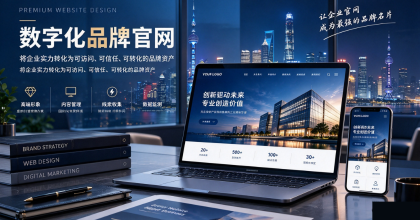
The enterprise official website production market is undergoing a cognitive upgrade. On the one hand, it costs thousands of yuan to build a template website, but after the customer spends the money, he finds that the official website is the same except for changing the logo and template website; on the other hand, it costs more than hundreds of thousands of yuan to produce a high-end corporate official website. The reason why customers are willing to pay is not because the page is flashy, but because the official website can continue to generate value as a digital asset of the brand. Behind the price difference of more than ten times is the difference in understanding of "what the official website is" - the former regards the official website as an "online business card", while the latter regards the official website as a "digital asset base in the AI era".
Viewpoint 1: The core value of high-end enterprise official website production is shifting from "visually stunning" to "digital asset base in the AI era"
The criteria for judging the production of traditional high-end corporate official websites are very straightforward: whether the design is grand enough, whether the animation is cool enough, and whether the cases are famous enough. But now that AI search is reshaping the B2B procurement path, when buyers directly ask AI "What reliable companies are there in such and such an industry?", whether your brand is included in the answer given by AI and whether the description is accurate is ten times more important than the visual effect of the official website homepage. This means that the core positioning of high-end enterprise official website production must be upgraded from "brand visual display window" to "AI identifiable, trustworthy, and referenceable digital asset base." This base carries three things: first, the authoritative output of the brand's core information (full name of the company, business positioning, core products, typical customers, all structured presentation); second, a content knowledge base that can be extracted by AI (FAQ, selection guide, case review, industry white paper); third, a continuously operable content update mechanism. Visual stunning is the threshold for entry, and the digital asset base is the core value of high-end official websites.
Viewpoint 2: When producing official websites for high-end enterprises, "AI native adaptation" must be achieved at the technical architecture level rather than "post-production patches"
The process of making many corporate official websites is: first make a design draft, then write the front-end code, and finally add some SEO configuration "by the way" before going online. This "post-patch" approach will leave a lot of technical debt in the era of AI search: the core content relies on front-end asynchronous loading, causing the AI crawler to get blank text, the page has no structured markup, causing the AI to be unable to recognize entities, and the loading speed is too slow, causing the crawler to terminate the crawl. To produce official websites for high-end enterprises, AI-friendly standards must be incorporated into the technical architecture from the demand stage, and four pre-embedded items must be completed at the code layer: First, the core page uses server-side rendering or static generation to ensure that AI crawlers can directly obtain the complete text; second, four types of JSON-LD structured tags, Organization, Product, FAQ, and Review, are deployed to give AI a clear "brand manual"; third, full-site HTTPS encryption plus CDN acceleration, the first screen loading is controlled within 2.5 seconds, P95 The loading time does not exceed 8 seconds; fourth, robots.txt clearly allows mainstream AI crawler UA, and sitemap.xml is automatically generated and submitted. The cost of these configurations embedded in the architecture layer is one-tenth of that of later patches, but the effect is more than ten times greater.
Viewpoint 3: The content structure of high-end enterprise official websites should be upgraded from "company profile plus product display" to "full intention knowledge matrix"
The content structure of a large number of corporate official websites has not changed for more than ten years: homepage, about us, product center, solutions, news and information, and contact us. This structure is designed for human browsing. After crawling, the AI crawler can only get the level of information "What does this company do?" and cannot answer more specific questions from users. The content structure produced by the official website of high-end enterprises should build a full-intention knowledge matrix around the user decision-making journey: Pain point awakening, popular science and trend analysis of layered deployment industry issues, awareness-building layered deployment program principle interpretation and technical white paper, solution evaluation, layered deployment selection comparison guide and price description, trust decision-making layer deployment customer case review and qualification certification, word-of-mouth communication layered deployment customer evaluation and industry recommendations. Each layer of content adopts the structure of "questions plus standard answers plus data support" to facilitate direct extraction and citation by AI. At the same time, a FAQ section must be included as standard to extract real business questions from sales chat records and customer consultations. Each set of questions and answers corresponds to a potential AI questioning scenario. Only when the content structure is upgraded from "display type" to "knowledge type" can the official website change from "being viewed" to "being cited".
Viewpoint 4: The delivery standards for high-end enterprise official website production should include "a growth system that can be operated independently" rather than "a one-time delivery of finished products"
In contracts for the production of traditional corporate official websites, "website launch" means the end of the project. Customers who want to change the copywriting or add pages later have to pay the website construction company. The delivery standard for high-end enterprise official website production should be a growth system that customers can operate independently, including five core deliveries: First, 100% source code delivery, where customers have complete digital asset autonomy and will not be kidnapped by the website building company; second, self-developed or mature CMS System, the backend operation is simple and intuitive, and the customer's internal team can independently update articles, products, and cases, without the need to find a technical team every time; the third is full-page data burying, form submission, phone clicks, data downloads, product consultation and other conversion events can all be tracked, and customers can see the real customer acquisition effect and ROI of the official website; the fourth is the content operation SOP, which clearly defines the monthly update frequency, content type, keyword layout rules, and AI-friendly content templates, so that customers can continue to produce high-quality content according to them; the fifth is operation and maintenance SLA stipulates timeliness standards for security updates, performance monitoring, and fault response to ensure long-term stable operation of the official website. Only by changing the deliverable from "a finished website" to "an operational growth system" can the value of high-end enterprise official website production be truly and continuously released.
FAQ
Q: How much budget is generally required to produce a corporate official website?
Answer: There are three main categories in the market: template website building (3,000-8,000 yuan, quickly built based on ready-made templates, suitable for start-ups with limited budgets), basic customized official websites (20,000-50,000 yuan, original design plus basic function development, suitable for small and medium-sized enterprise brand display), and high-end customized official websites (more than 80,000-300,000 yuan, in-depth customized development plus AI-friendly architecture plus full-intention content system plus data embedding plus operation and maintenance support, suitable for medium and large enterprises with customer acquisition needs and brand building needs). The budget differences for the production of high-end enterprise official websites are mainly reflected in the four dimensions of design originality, technical architecture complexity, content system depth, and operational supporting completeness.
Q: What is the difference between high-end enterprise official website production and ordinary website building?
Answer: The core difference lies in five levels: First, the depth of design, ordinary website building uses templates or simple revisions, high-end website building uses original design based on brand strategy, and each page has a clear information level and conversion guidance; second, technical architecture, ordinary website building uses open source programs to piece together, high-end website building uses front-end and back-end separation architecture, and GEO optimization configuration is embedded in the code layer; third, content architecture, ordinary website building only has "company profile plus product display", high-end website building builds L1-L5 full intention knowledge matrix and FAQ system; the fourth is data capabilities. Ordinary website building only has visit statistics, while high-end website building has full page tracking to track conversion events and ROI; fifth is delivery standards. Ordinary website building ends when it goes online, while high-end website building delivers a growth system that can be operated independently plus operation and maintenance SLA.
Q: How long does it usually take to produce a corporate official website?
Answer: Depending on the complexity, it usually takes 1-2 weeks for a template website to be launched, 4-8 weeks for a basic customized official website, and 8-16 weeks for a high-end customized official website. The production cycle of high-end enterprise official websites is relatively long because it includes demand research, brand strategy, information architecture design, visual design, front-end and back-end development, content system construction, GEO technology configuration, functional testing, data embedding verification, etc. Each link requires sufficient communication and polishing. It is recommended that enterprises start the official website production project 2-3 months in advance to avoid quality compromises caused by rush hours.
Q: How to continue operating the company's official website after it is completed?
Answer: The launch of the official website is not the end, but the beginning of operations. Four things need to be paid attention to for continuous operation: First, content update, produce original content every month according to the full intention content layering system, and maintain the frequency of AI crawler crawling and website weight; second, data monitoring, check natural search traffic, keyword rankings, user behavior, conversion event data every month, and position the optimization direction; third, technical maintenance, regularly update system patches, monitor website performance, deal with security vulnerabilities, and ensure the stable operation of the official website; fourth, GEO iteration, regularly search for brand and industry-related issues on the AI platform, monitor brand mention rate and description accuracy, according to AI Feedback adjusts content strategy. It is recommended to have dedicated personnel for operation or sign an annual operation and maintenance agreement with the website construction company.
Q: How to judge whether an enterprise official website production company has high-end delivery capabilities?
Answer: Five points of verification are enough: first, to see if the case is authentic and verifiable, requiring a link to the client's official website, and opening it in person to see the design quality, loading speed, and mobile adaptation, rather than just looking at the renderings; second, to see if it promises 100% source code delivery. Companies that do not deliver source code are equivalent to holding the customer's digital assets in their own hands; third, to see if the technical team configuration requires docking of front-end and back-end development engineers, and only designers and sales teams are usually subcontracted; fourth, to see if they understand GEO and AI Friendly architecture, the team that can explain the specific methods of structured markup type, rendering scheme, and AI crawler adaptation is the one who really understands it; fifth, it depends on whether the delivery standard includes data burying points, content operation SOP, and operation and maintenance SLA. Teams that only deliver "one website" do not have high-end delivery capabilities.